Search This Blog

Followers

Tuesday, June 8, 2010

The Thailands Scariest Amusement park

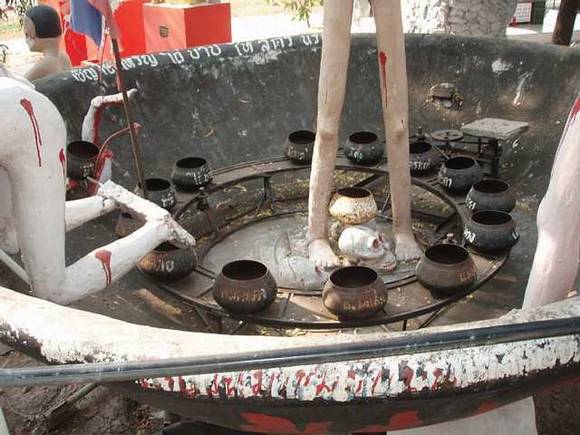
This is no amusement park as a single visit can give you nightmares to last a lifetime. The children will probably not sleep at night or be in someway scarred psychologically. The statues are of naked people hurt in some way or the other. The gory statues show blood covered bodies and one of them is of naked people climbing a giant cactus. Another statue is that of somebody being hanged. Although they aren’t very lifelike, it is hard to not get creeped out.


Monday, April 5, 2010

Circling the globe without stepping on an airplane

Seth Stevenson
Subject: A Freighter Across the Atlantic Ocean
Posted Monday, April 5, 2010, at 7:10 AM ET

We have no tickets for our freighter. Just a piece of paper I printed out at home so I'd remember the name of our ship—the Independent Endeavor—and the address of the terminal. The travel agency assured us our arrival would be expected.

A few decades ago, you could walk out onto a shipping dock and talk your way aboard a freighter, convincing the captain to give you a bunk or a spot on the floor. Maybe you'd work for your passage by swabbing decks. Maybe you'd just slide the captain a wad of cash. Whatever the arrangement, it was not unusual for a cargo ship to accept last-minute passengers.

Those days are long gone. The golden era of freighter hitchhiking came to an end sometime around the mid-1970s. As with all great adventures, casual freighter travel stopped the moment the lawyers showed up. Shipping companies decided that, due to some pretty glaring liability and security issues, it would be insane for them to continue allowing their captains to take on random passengers. Nowadays, you can't get on a container ship without making reservations weeks in advance.

(Unless you secretly stow yourself inside one of the containers. Which I don't recommend. You could die that way. Even if you survived, you'd endure spooky darkness, brutal heat, and unbreathable air. A 1994 New York Times story about a group of stowaways from the Dominican Republic featured the evocative subhead "Three Days at Sea in Foul Box." The stowaways were discovered when a deckhand heard desperate shouting and banging coming from a container perched forty feet above the ship's deck.)

The boarding process for your average cruise ship—one of those big, white Caribbean gluttony tubs—begins with thousands of passengers in a snaking velvet rope line on the pier. A squad of cruise ship workers, all fake smiles and elaborate epaulets, will load piles of luggage onto bellhop trolleys. They'll lug these bags to the passengers' cabins, make sure everyone's safely on board, and then point the way to the pasta buffet.

There's no such service as we board our freighter. Instead, a single Filipino deckhand, wearing a blue jumpsuit and orange hardhat, leads us in a scramble a hundred feet or so up a temporary metal ladder that's been lashed to the side of the ship. At the top of the ladder, we step over a yawning precipice and onto the freighter's deck. Here we're briefly introduced to the ship's first and second officers—one German, the other Romanian, both far too busy to pay us any mind. The deckhand leads us up a dimly lit interior staircase, then down a claustrophobic hallway lined with mysterious clamped hatches. He points to a door and nods. Apparently, we've arrived at our cabin.

I actually prefer this gruff efficiency to the icky sycophancy of a cruise ship's hospitality workers. In fact, Rebecca and I are sort of pleased that we're not—as we would be on a cruise ship—the central focus and purpose of this journey. We're just two ancillary pieces of cargo that the crew needs to deliver safely.

The ship's 3rd officer is a smiley Filipino guy named Gregorio. After breakfast, he takes the only four passengers on board (me, Rebecca, and Frank and Daphne—a retired couple in their seventies) out onto the main deck for our required safety lecture. In halting English, he describes the procedures for various emergencies.

First, Gregorio demonstrates how to use the "immersion suits" the ship has provided us with. These suits are thick, one-piece, neoprene coveralls that zip over our clothing. They feature a built-in lifejacket, a blinking distress light, and a whistle. They're meant to help us retain core body heat if, for some unfortunate reason, we are obliged to enter the frigid Atlantic Ocean without aid of a lifeboat.

The suits look like a child's footie pajamas. They're puffy, to provide warmth, and they're bright orange so they can be easily spotted from the sky. Daphne is appraising them rather doubtfully. I imagine her tiny frame bobbing gently in the swells, waiting for rescue.

The immersion suits explained, Gregorio moves on to the ship's alarm signals. Each different signal has a specific meaning. One pattern of horn blasts signals an emergency, "like if the ship sinks," as Gregorio delicately puts it. If we hear this signal, we're supposed to gather at a designated muster station. (This assumes the muster station is still peeking out above the waves.)

A second horn pattern signals a fire—in the event of which, again, we are to head for the muster station. (Assuming the muster station is not itself aflame.)

The third and by far most intriguing alarm is for a security alert. "Like if there are pirates," says Gregorio. I ask if, in the event of a pirate raid, we should gather at the muster station. "No!" says Gregorio. "Stay in your cabins and wait for the captain to give instructions over the loudspeaker. Because the pirates might be at the muster station!"

As we learn on our first day at sea, there's not much to do aboard a cargo freighter. No TV. No Internet. No restaurants, no bars, no fitness centers. No cliques of passengers to meet or planned activities to join.

There is, however, a lot of peace and silence. We'd grown used to the noisy bustle of our D.C. lives—cell phone calls, television blather, honking rush hour traffic on the streets outside our apartment. The quiet we experience lounging on the fo'c'sle is almost startling.

The isolation of the ship is also a very welcome data detox. I can't remember the last time, before today, that I went more than a few waking hours without checking my e-mail. Rebecca and I and everyone we know are all addicted to the constant flow of data and chatter. But after one afternoon out here on the freighter, I find I couldn't care less what's piling up in my in-box or streaming across my favorite websites and blogs. What does it matter? It suddenly seems so trifling set against the ancient silence of the ocean.

During the day, when we're not at meals, Rebecca and I read in adjacent plastic deck chairs in the sun. When we want a break from our books, we stroll around the open-air parts of the ship—scouting with our binoculars for seabirds and maybe dolphins or whales. We've had no luck so far spotting ocean mammals, but hopes remain high.

At night, we put on sweaters and brave the salty evening chill. The stars twinkle against a pitch-black sky. No city lights here to turn the atmosphere milky.

We get our sea legs after the first day and become accustomed to the ship's slow, steady roll. It's wonderful to be rocked to sleep by it. It's so constant and powerful, it even seeps into our dreams. Rebecca keeps having this nightmare that she's back in her law firm's office tower and the building is undulating as though it's in an earthquake. File drawers rolling open. Casebooks spilling off shelves.

Then she wakes up and remembers that she left all those things behind.

Monday, November 2, 2009

Joshua Tree National Park is an often-overlooked treasure

By Tom Uhlenbrock
ST. LOUIS POST-DISPATCH
Sunday, Nov. 01 2009
JOSHUA TREE NATIONAL PARK, CALIF. — Yosemite, Yellowstone and Grand Canyon get
the publicity, and the visitors. But there are plenty of lesser-known national
parks that offer gorgeous vistas and pristine back country, far from the
maddening crowds.

Joshua Tree, Big Bend, Capitol Reef, Isle Royale, Kenai Fjords and Theodore
Roosevelt are national parks that may never be the stars of a Ken Burns
documentary. But each offers its own charm, and you won't find a traffic jam at
any of them. In fact, Kenai Fjords in Alaska and Isle Royale in Lake Superior
have no traffic at all; you explore them by boat or by sea plane.

When I visited Theodore Roosevelt in remote western North Dakota and asked the
ranger whether he was busy with visitors that day, he replied, "You're No. 2."

Franklin Roosevelt made Joshua Tree a national monument in 1936, and Bill
Clinton elevated it to a national park in 1994. The park is well known in
Southern California but, like some Americans living elsewhere, I first heard of
this eerie expanse of cactus-studded desert and mountains in 1973 after the
strange death of Gram Parsons, a singer-songwriter who was a member of the
Byrds and a pioneer of country-rock music.

Parsons, who may be best known for his later duets with Emmylou Harris, died of
an overdose in the Joshua Tree Inn, where his admirers still maintain a
makeshift memorial of candles, flowers and a tiny guitar in the sandy courtyard
outside the blue door of room No. 8.

In the days after his death, two of his drunken buddies absconded with Parsons'
casket and tried to fulfill his wish of being cremated in the Joshua Tree
desert.

The purported spot where the body was partially burned is in the vicinity of
Cap Rock, one of the park's geologic landmarks. A nearby rock face is scrawled
with messages, some put there as recently as this year by fans still mourning
35 years later.

Ranger Pat Pilcher, who gave me a tour during my three-day visit to Joshua
Tree, said the National Park Service does not encourage visits to the site or
the resulting graffiti.

"We don't officially sanction it," Pilcher said. "But it's in the circuit. It's
not like it's a secret, obviously."

Like many national parks, Joshua Tree had a prime mover. Minerva Hamilton Hoyt,
a Mississippi belle who moved to Southern California, founded the International
Deserts Conservation League in 1930. She worked to preserve the landscapes that
were being devastated by cactus collectors and vandals, and lobbied Roosevelt
to protect the area.

The national monument was named Joshua Tree for the forests of dagger-leaf
plants that dominate the high-desert valleys. Early Mormons, who named the
trees, thought they looked like the prophet Joshua summoning his followers.

The park's other noted image is its rock piles, which come in fantastic shapes
and sizes. Some are spheres, some are stacked like a giant's blocks. All were
formed by 90 million years of erosion.

"That's the question we get the most," Pilcher said. "Who piled those rocks up
like that?"

A FAMILY OF PACKRATS

Although Joshua Tree is within a few hours' drive of the 18 million inhabitants
of Los Angeles and San Diego, it is easy to be alone in the nearly 800,000
acres of the national park, 80 percent of which is designated wilderness. On my
arrival, I made the short but steep climb to the top of Ryan Mountain for a
360-degree look at the park at sunset. The summit was crowded with two other
hikers.

The next day, an eight-mile, round-trip hike took me through the low desert to
Lost Palms Oasis, a hidden valley filled with the park's largest grove of
stately fan palms. The only sounds were the rustling of the palm fronds and the
song of a cactus wren.

Nights were spent at the 29 Palms Inn, which was built in the 1920s, maintains
a funky ambiance and has the best restaurant in the town of Twentynine Palms.
The area also is home to the world's largest Marine base, which contains
simulated Iraqi villages for practicing desert warfare.

The Joshua Tree lore includes stories of the McHaney Gang of rustlers and
prospectors who filed about 300 claims in their search for gold. Some hit pay
dirt; most found dry holes.

Pilcher, the ranger, opened the locked gates for a visit to the homestead of
the William Keys family. Keys was a caretaker for the Desert Queen Mine, one of
the few successes, and he took over the property in 1917 after the mine owner's
death. The nearest town was a six-day ride by horseback, so Keys and his family
scavenged the mining operations for any bit of equipment that might help them
eke out a living in the harsh terrain. A cyanide tank became a chicken coop, an
old tractor was jury-rigged to cut wood.

"They were packrats, this is their Home Depot hardware department," Pilcher
said in a yard full of tables stacked with rusted nuts, bolts and tools. "They
had to haul all this stuff in by horse and wagon, and everything was cobbled
together. I'm amazed at their ingenuity."

The park service maintains the homestead exactly as it was when Keys died in
1969.

AN ICONIC LANDSCAPE OF THE WEST

Perhaps the most amazing story of Joshua Tree is the plants and wildlife that
are able to survive in a climate in which the summer temperature reaches 115
degrees and the average annual rainfall is 4 inches. This year has been
especially dry; the park had recorded a meager 0.56 inch of rain by mid-October.

The desert tortoise, which is federally listed as threatened but holding its
own in the park, lives most of its life protected from the heat in underground
burrows.

The spindly branches of the ocotillo plant appear to be dead until they burst
forth with green leaves and flame-red flowers at their tips with the slightest
bit of rain. Indeed, about half of the park's 1.3 million annual visitors come
February through May, when the temperature is mild and rain turns the desert
floor into a carpet of wildflowers.

"Some 250 species of birds occur here, and there are 800 species of plants in
the park — they're finding new ones all the time," chief interpreter Joe Zarki
said. "There are two desert ecosystems, the Mojave and Colorado deserts, and
six mountain ranges. We are one of the most famous rock-climbing sites in the
world and have some 270 miles of hiking trails."

The park does have its problems, especially because of its location within the
suburban sprawl and smog of Southern California.

"If you get out to Keys View on a clear day, you can see 90 miles into Mexico,"
Zarki said. "But that's limited to a few days out of the year now."

Exotic grasses also have moved in and provide tinder for fire from lighting
strikes that normally would burn out on the bare ground. The park's larger
plants, such as piƱon, juniper and its signature Joshua trees, are not adapted
to fire and take many years to recover, altering a landscape that attracted
people like Minerva Hamilton Hoyt, Gram Parsons, and today's TV and film
producers.

"Since we're so close to Los Angeles, we get a wide variety of television
commercials filmed out here," Zarki said. "The rocks, the boulder formations,
which are of endless variations, all ringed by Joshua trees, it's one of the
iconic landscapes of the West."

Sunday, October 18, 2009

The "Miniatur Wunderland"


The "Miniatur Wunderland" model railroad in Hamburg , Germany is the largest in the world, covering 16,146 square feet of space with more than 10,000 train cars running around its 6.8 miles of HO scale track. Now, the makers of this huge layout have created a video that gives you a jaw-dropping look at the vast scope of this intricate work of art.

Its construction started in 2000, and is still underway, with a tiny airport due for completion by the end of this year. This is just the beginning — there are plans to double the layout by 2014. We especially like the Las Vegas portion, complete with dazzling LEDs lighting up the night.

You have to watch the video below to get the full impact of this remarkable achievement, which has taken in excess of five hundred thousand working hours to build. There's good reason why this is Germany 's most popular attraction, already visited by more than five million flabbergasted tourists.